
Elkhart Previous Residents by Era
Start with the source closest to the date being studied. Deeds follow legal interests in land, directories record selected occupants in an edition year, and census schedules capture a household at one point in time. Maps and permits describe the building more than the people. Taken together, they make a dated trail of previous residents without blurring owner and occupant.
| Source | Years covered | Where held | What it can show |
|---|---|---|---|
| County deed books and indexes | County-era records from 1830; FamilySearch catalog 1830-1915 | Recorder, FamilySearch, State Library microfilm | Parties, legal description, instrument and title chain |
| Elkhart city directories | Listed editions from 1874 through 2015, with gaps | State Library, EPL, GPL, Internet Archive, licensed databases | Dated name, spouse, address and directory notation |
| Federal census | Public schedules through 1950 | NARA and library databases | Point-in-time residence and household |
| Sanborn maps | Local sheets from 1885 through 1950, in listed runs | State Library and Library of Congress | Footprint, street number, use and materials |
| Permit and code files | Online route current; historical span not stated | City Permit Center or APRA request | Construction, inspection and dated party lead |
| Obituary and probate sources | EPL obituary coverage described since 1921; court range varies | EPL, newspapers, clerk and microfilm | Family, last-address, estate and transfer clues |
For a recent address, begin with Beacon and the Recorder. For an older house, keep the same legal description while moving among deed books, directory editions, Sanborn sheets, and census schedules.
The Indiana State Library Elkhart County guide identifies local historical routes.
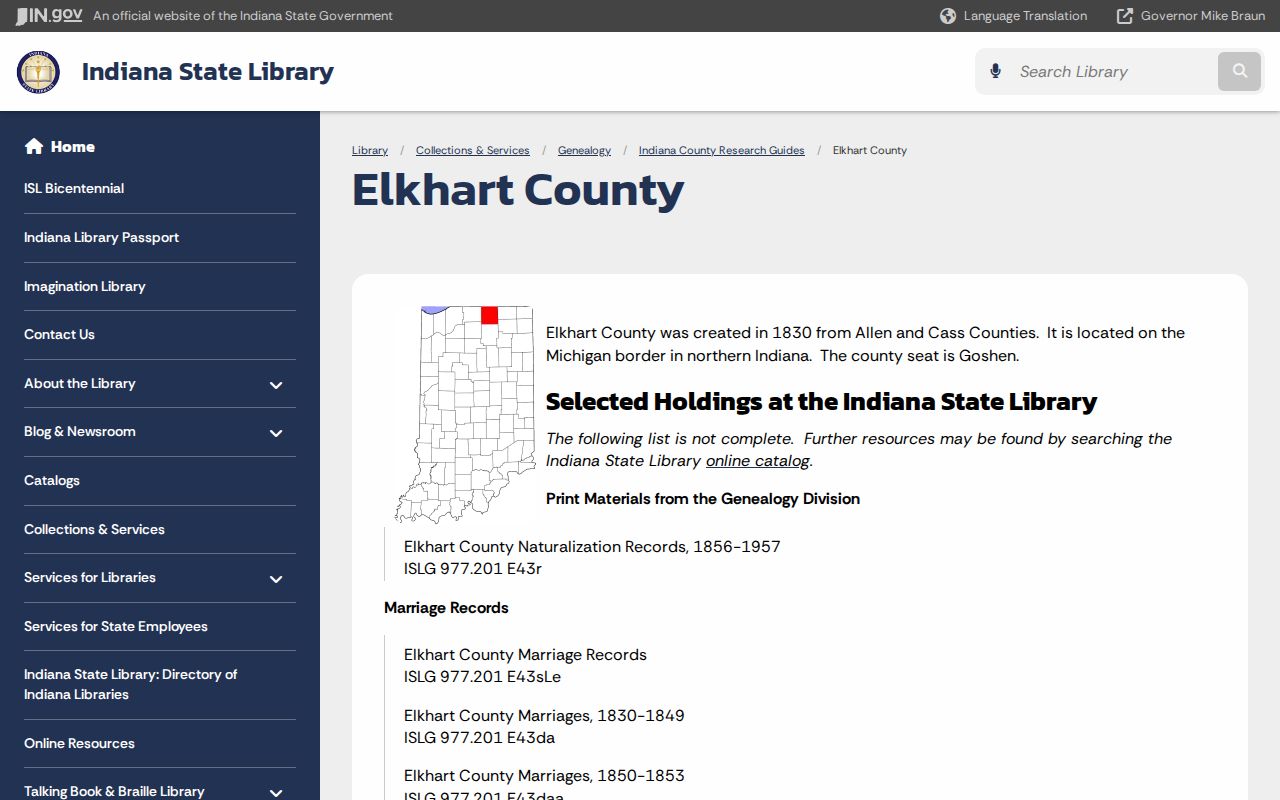
The guide helps route a gap to the right index, microfilm series, or original custodian.
Trace Elkhart Previous Owners Backward
Begin with the current parcel card, not an old surname. Save the exact situs, parcel number, legal description, owner and mailing address, sales line, and card date. Then use the latest transfer as an entry into the Elkhart County Recorder index. The Recorder offers Tapestry, Laredo, public computers, phone, mail, and in-person copy channels, but staff do not perform a full title search.
- Find the present parcel in Beacon and retain its legal description and current assessed owner.
- Locate the deed in which that owner appears as grantee, the party receiving an interest. Save the instrument number, dates, type, grantor, grantee, legal description, and prior reference.
- Search the seller or grantor as a prior grantee. Compare the legal description before joining the two records.
- Repeat backward. Classify quitclaims, mortgages, releases, affidavits, probate deeds, and tax deeds instead of treating each as a normal sale.
- When the online index stops, move to the Recorder's public computer, FamilySearch catalog, or State Library microfilm guide.
- Grantor and grantee
- The grantor gives or transfers an interest; the grantee receives it.
- Chain of title
- The documented sequence of transfers affecting the same land.
- Legal description
- The lot, block, subdivision, or boundary wording that can outlast a street address.
The county does not state one verified year when current Tapestry coverage begins. That is a real research limit, not a blank to estimate. FamilySearch's catalog covers Elkhart deeds from 1830 through 1915, and State Library microfilm lists later groups.
Elkhart Directories Fill Ownership Gaps
A deed party may never have occupied the house. A dated directory can add the missing household layer. Search the address section or criss-cross arrangement when present, then test the surname section for spouse, occupation, employer, and abbreviations such as res or bds. Publication lag and omissions mean that no entry is not proof of absence.
The open 1890 Elkhart city directory provides an early searchable edition.
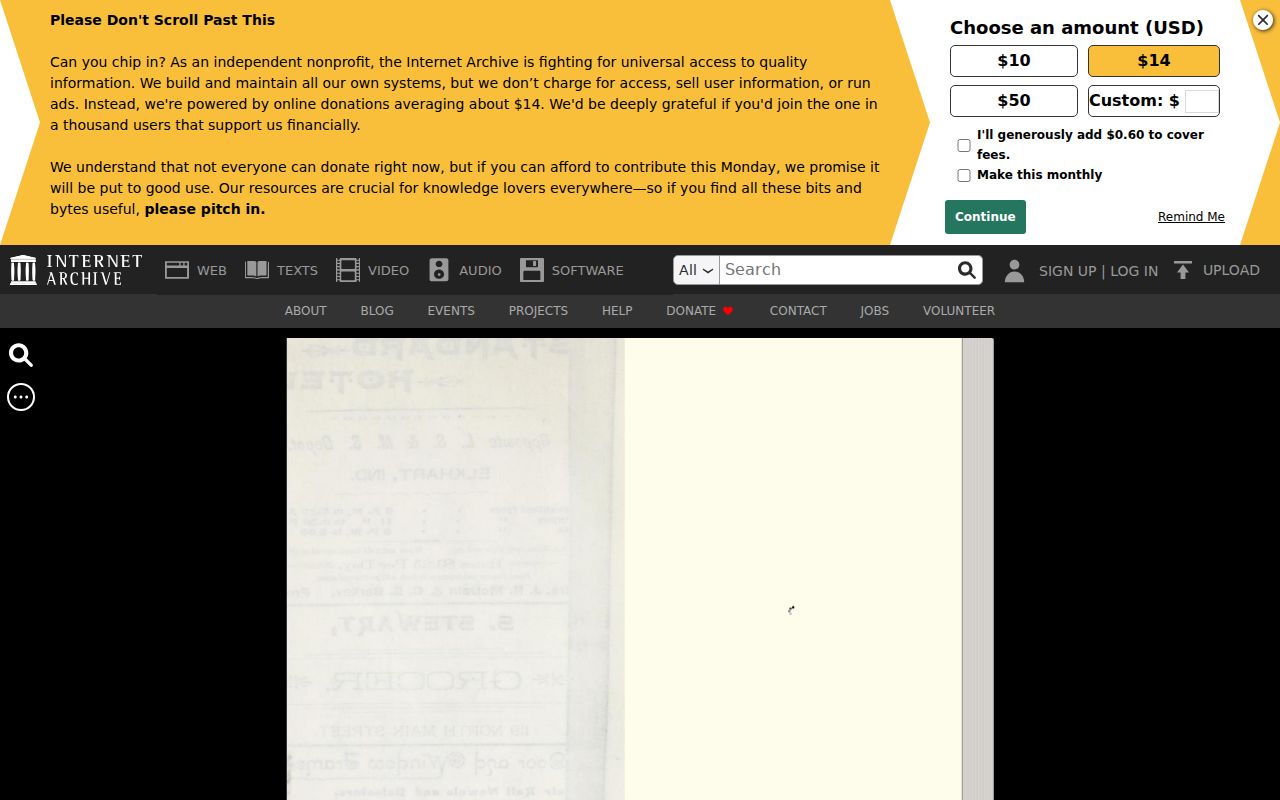
Its entries supply a dated clue that should be checked against the deed and map evidence for the same period.
The 1904-1905 Elkhart directory bridges another documented interval.
Comparing editions can reveal a move, a change in house number, or the arrival of a new listed household.
Full publishers, holdings, and edition runs are handled on the Elkhart city directory page. Previous-resident work uses only the editions that bracket a transfer or census date.
Pair Elkhart Residents With Census Years
Directory and census evidence answer different questions. A city directory may list one householder and a spouse. A census can show the full enumerated household at a specific date, but spelling and street boundaries may vary. Pair them in a fixed process.
- Select the directory edition just before or after a public census year.
- Record the address exactly, including an old street name, directional prefix, and directory abbreviations.
- Find the census household using the name and address together. If indexing fails, use the enumeration district, the census area assigned for counting.
- Compare ages, relationships, occupations, and nearby households. Treat each mismatch as a question, not a fact to smooth over.
- Verify an apparent move through the next directory, a deed, obituary, probate file, cemetery record, or permit.
This sequence distinguishes previous residents from an owner who received mail elsewhere or a person who merely boarded at the address.
Elkhart Previous Residents in Print
The digitized 1912 Elkhart directory is an open bridge between early deeds and later census work.

The page image preserves abbreviations and printed order that a loose text result may omit.
The 1922 Elkhart directory offers a later comparison point.
Use the two volumes around other dated sources rather than assuming the same household remained for the full decade.
Old Elkhart Addresses Change Names
An address search can fail even when the family stayed put. Elkhart's official street-change table records Lincoln Street becoming South Second in 1887 and Vistula becoming East Jackson in 1889, with many later changes. The annexation table also shows areas entering the city across decades. Search both historical and current names, and keep the addition, plat, or legal description as the bridge.
A source crosswalk should list the year, printed spelling, modern spelling, house number, lot and block, annexation context, and evidence used to connect them. Do not join two addresses solely because the numbers match. A split parcel or road extension may reuse or shift a number.
Note: The assessor guide says parcel-number searches must include 20; preserve the returned number rather than reconstructing its format.
Map an Elkhart House Through Time
Sanborn fire-insurance maps date the physical setting. Elkhart sheets are documented for 1885, 1889, 1892, 1896, 1901, 1910, 1917, 1927, and later revisions through 1950. A sheet may show a footprint, use, street number, building material, and nearby landmark. It does not identify every occupant.
Permits can add construction, remodeling, inspection, demolition, or applicant evidence. The City Permit Center has a current application route, but no complete historical public address index was verified. Ask through the city APRA form for an exact address, record class, and date range. Newspapers may also report real-estate transactions or building permits.
The Elkhart County Historical Museum is another source for photographs, maps, family files, and local context.
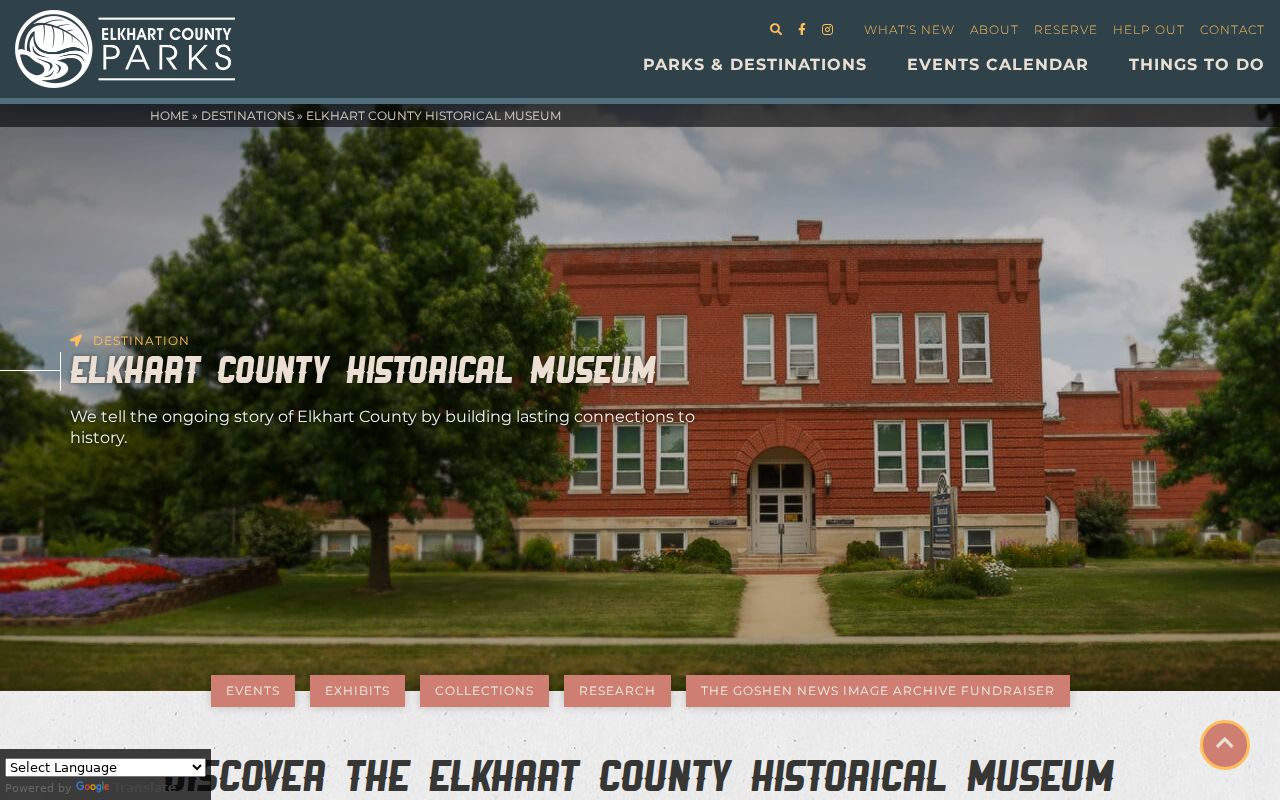
Museum material can explain the setting around an address, but names should still be checked against a dated directory, deed, or custodian record.
Close Elkhart Resident Trails Carefully
Obituaries, funeral-home files, cemetery records, probate, and court files can explain why a name disappears. Elkhart Public Library describes obituary coverage since 1921, while the city cemetery page offers an interment-map route for three cemeteries. Probate may identify heirs, an estate representative, an address, or a property disposition.
These are trail endpoints, not shortcuts. An obituary is secondary evidence until checked against the named record keeper. A probate case may be partly confidential. If a trust, corporation, estate, or joint owners replace a surname in the deed chain, search the instrument type and legal description before concluding that the household moved.
Naturalization, marriage, delayed-birth, and will indexes can bridge an earlier gap. The State Library guide identifies Elkhart County naturalization records from 1856 through 1957, will records from 1845 through 1881, delayed births filed from 1941 through 1963, and several marriage runs beginning in 1830. Those dates describe collections, not a guarantee that each original page is online. Use the index citation to request the named volume or case from its custodian. A marriage or probate reference may connect surnames across directory editions, while a naturalization entry can distinguish two people with similar names. Keep that relationship evidence separate from proof that either person occupied the address.
When online coverage fails, use the library, Indiana State Library, FamilySearch, Genealogical Society, Recorder terminal, and Clerk. Phone or mail requests should state the parcel or address, record type, date range, and whether inspection, an ordinary copy, or a certified copy is wanted.
Separate Elkhart Owners and Occupants
Previous residents are not the same as previous owners. A deed proves that named parties had a role in an instrument. An assessor card shows an assessment relationship. A directory records a selected occupant in one edition. A census records an enumerated household. A permit shows a dated applicant or project. Keep those meanings distinct.
Write the trail as documented links: current parcel to current instrument, prior seller to earlier deed, legal description to old address, and directory or census to a dated occupant. At each link, label whether the connection is direct evidence or an inference. If only an index row exists, call it an index lead until the image is reviewed.
Lawful use. Research Elkhart previous residents for house history, genealogy, estates, and personal curiosity. Never use a historical trail to track, harass, intimidate, or harm a living person.